

Auto Repair Estimate Template (Free PDF & Excel): How to Write It, Parts and Labor, and Getting the Customer's ApprovalVehicle details, parts and labor on separate lines, and the yes in writing.
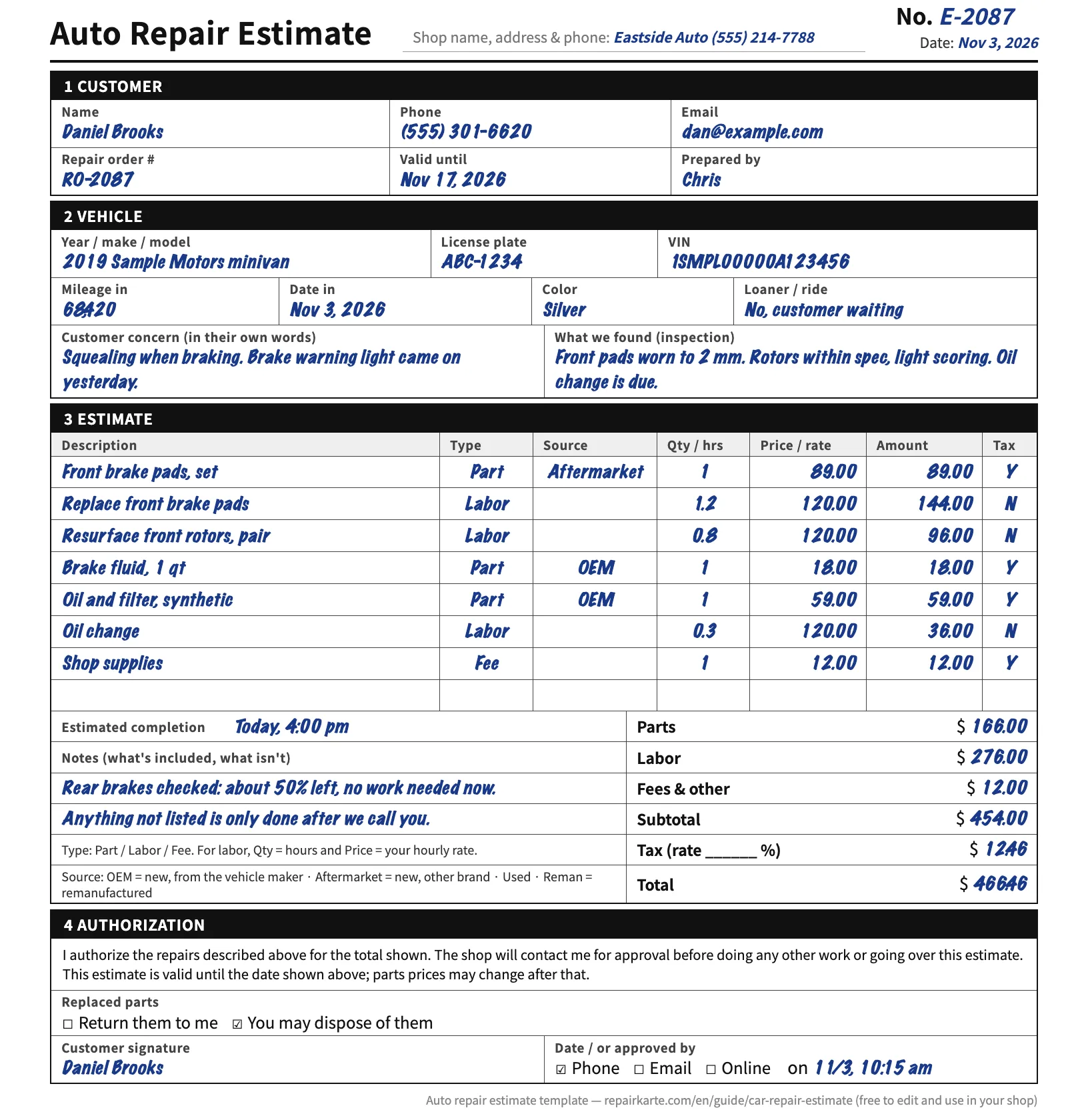
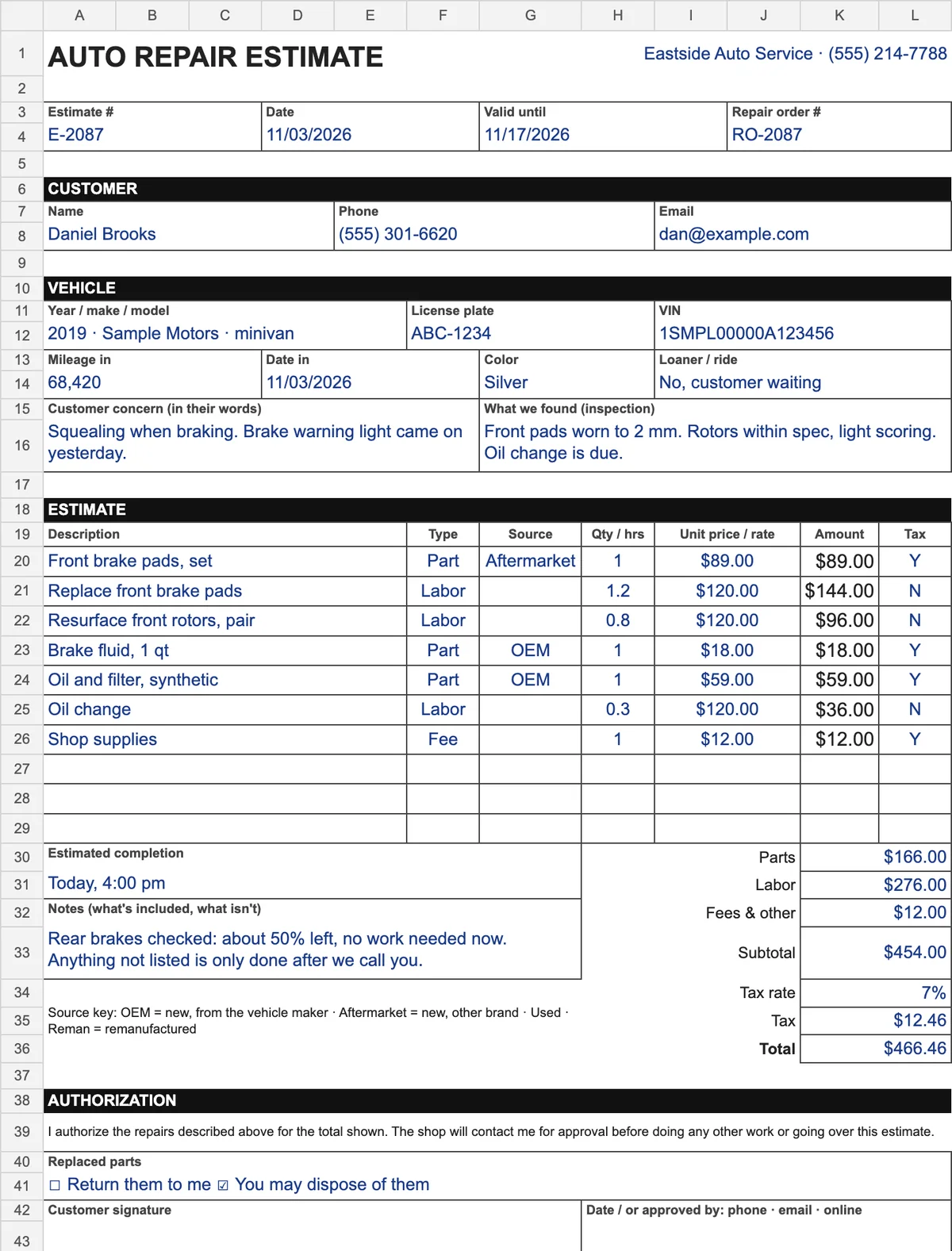
One page with vehicle details, eight lines for parts and labor, totals and an authorization line
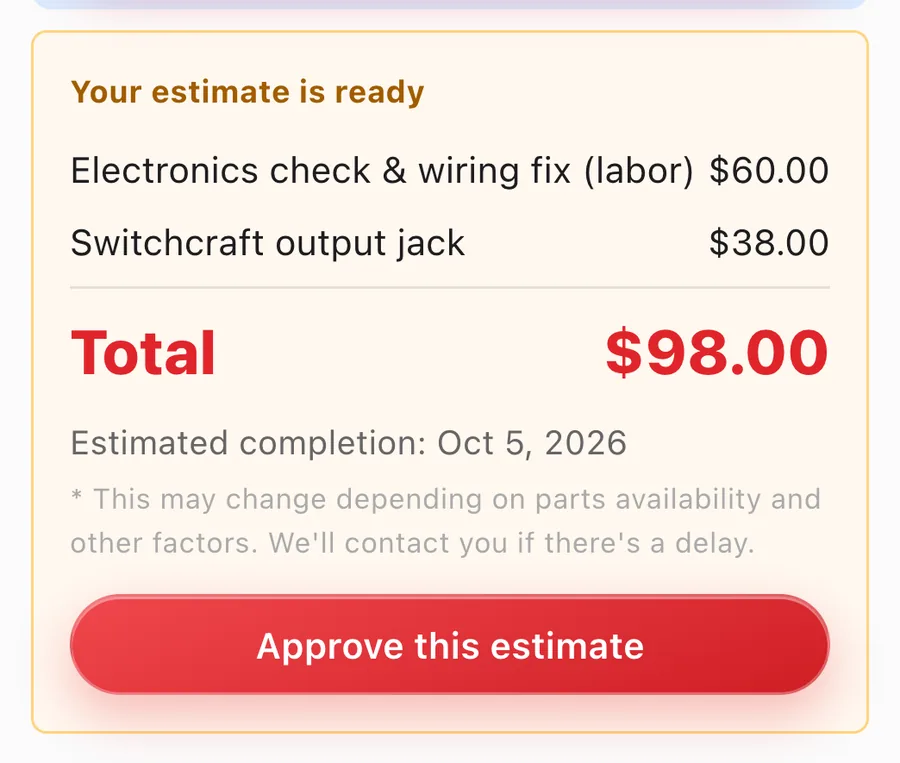
The estimate goes to the customer's status page, where they slide to approve
The PDF and Excel files are free, with no sign-up or email (PDF in US Letter and A4; Excel on one US Letter page, with your own tax rate).
What you'll learn
- What goes on an auto repair estimate
- Writing parts and labor, with a filled-in sample
- Getting the approval, and handling extra work
Contents
01Start with the finished estimate
A good auto repair estimate identifies the vehicle, says what the customer reported and what you found, lists each part, labor job and fee on its own line, and shows the total with tax, the completion time and how the customer approved. Get that approval in writing (a signature, an email reply or an online approval) and most arguments at pickup never start.
- 1One line per part or labor jobPart source, labor hours and rate
- 2Totals, then taxTax only on the taxed lines
- 3Record the yesAnd what to do with the old parts
02How to write it, in five steps
- 1Vehicle details
- 2Concern, then findings
- 3Parts and labor
- 4More work rule
- 5Yes and old parts
Copy the vehicle details
Year, make and model, license plate and VIN from the vehicle or its registration, and the mileage on the odometer when it came in. With the VIN, ordering the right parts is quicker.
Write the concern, then what you found
First the problem in the customer's words, then what the inspection showed. If you can't know until it's apart, quote the diagnosis first and say so.
One line per part, labor job or fee
Parts with their source and price, labor as hours times your rate, and fees such as shop supplies on their own line. A single "Brake job: $466" invites haggling; a list explains itself.
Say what happens if you find more
Cars often turn up a second problem once they're apart. Write that you'll stop and call first, so extra work becomes a new yes, not a surprise on the bill.
Get the yes, and ask about the old parts
A signature at the counter, a reply to your email, or a note of the date and time they said yes on the phone. Ask now whether they want the replaced parts back.
03What to put on an auto repair estimate
| Field | Why it's there |
|---|---|
| Estimate number, date, valid until | A number to refer to on the phone, and a date after which the price may change. Parts prices move. |
| Repair order number | Ties the estimate to the vehicle in your bay and to the work order the technician follows. |
| Customer: name, phone, email | Who approves, and how you'll reach them fast if you find more work once the job is under way. |
| Year, make, model | Copy it from the registration or the vehicle. The same model in a different year can take different parts. |
| License plate and VIN | The plate tells cars apart in the lot; the VIN is what you look parts up by. |
| Mileage in, date in | The odometer reading when the car came in. It settles questions about miles driven while it was with you. |
| Customer concern and what you found | The problem in the customer's words, then what the inspection showed. Keeping them apart shows why each line is there. |
| Line items: parts, labor and fees | One line each, with the part source (OEM, aftermarket, used, reman) and, for labor, the hours and your rate. |
| Parts, labor, fees, subtotal, tax, total | Tax only on the lines that are taxed where you are. Show the total the customer will actually pay. |
| Estimated completion | The question every customer asks next, and the one that decides whether they need a ride or a loaner. |
| Notes: what you checked, what isn't included | "Rear brakes about 50%, no work needed now" tells the customer you looked, and sets up the next visit. |
| Authorization and replaced parts | Signature, or when and how they said yes. Ask whether they want the old parts back before you throw them away. |
Show the total the customer will actually pay, with tax.
04Writing parts and labor
Put each part on its own line with its source and price, and each labor job on its own line as hours times your rate. Fees such as shop supplies get a line too. The customer can then see what each piece costs, and say yes to some lines and not others.
Part sources
Write the source on every part line, so the customer knows what they're approving.
New, from the vehicle maker or its supplier. Usually the highest price, with the fewest questions about fit.
New, from another brand. Often less than OEM; quality varies by brand and part.
A used part taken apart, with worn pieces replaced, and rebuilt. Common for alternators, starters and similar parts.
Taken from another vehicle as it is. Usually the lowest price; condition differs from part to part.
05Getting the approval, and when you find more work
Whichever way the customer says yes, write down when, how and to what amount. The authorization line at the bottom of the template has room for all three, and for what to do with the old parts.
Go through the estimate together, show the worn part if you have it, and get a signature on the authorization line.
Read out the total, the work and the completion time. Then write the date, time and who took the call on the estimate.
Send the estimate with a photo of what you found and ask for a reply such as "Go ahead". Keep the reply with the estimate number.
The customer approves the estimate on a page you send them, and the approval is recorded for you.
When you find more work once it's apart
Stop, and take a photo of what you found.
Tell the customer the parts and labor for the extra work, and how it changes the completion time.
Once they say yes, add the lines to the estimate (or write a second one) with the date, time and how they approved.
Don't start the extra work until you have that yes.
Some places have rules about written estimates and approvals for auto repair. Check the rules where you work.
After the yesLetting customers follow the repair online
06Common misunderstandings, and how to avoid them
"I thought it was the total"
The customer remembers the parts price and forgets labor, fees and tax. Put the total, with tax, in the biggest type on the page.
Extra work done without asking
Even a small addition feels like overcharging when it shows up unannounced. Stop, call, add a line and get a second yes.
No part source on the estimate
You quoted aftermarket or reman and the customer assumed OEM. Write the source on every part line.
Old parts thrown away without asking
Some customers want to see or keep what came off their car. Ask at approval, and tick the box on the estimate.
No valid-until date
An estimate approved months later can carry last season's parts prices. Write a date, and quote again after it.
Approved on the phone, disputed at pickup
Without a note of when they said yes and to what, it's your word against theirs. Write the date, time and amount on the estimate.
Three questions usually come up around an estimate. Whether to charge for the inspection itself: repair diagnostic fees. What you promise after the work: repair warranties. And an estimate for repairs other than cars: the repair estimate template.
07From paper to digital
Try it in Repair Karte
In Repair Karte the estimate lives on the repair's record, so the customer can approve it without a phone call and the approval is saved where you'll look for it.
Ask for the plate and mileage at check-in
Add your own check-in fields in Settings. If your shop type is Automotive, License plate and Mileage are there as examples you can add in one click (every plan).
The customer approves on their status page
Save the estimate on the repair's record and it appears on the customer's status page, where they approve with one slide or decline (every plan).
The estimate is emailed, with a reminder if there's no answer
On Standard and Pro, the estimate is emailed automatically when you move the repair to Estimated, and a reminder can go out if they haven't answered.
Print it on paper when you need to
You can also print a one-page estimate with the same line items on every plan; from Standard it carries a QR code to the status page.
Free plan: up to 100 repairs a month.
08Frequently asked questions
What should an auto repair estimate include?
The customer, the vehicle (year, make, model, license plate, VIN and mileage in), the concern in the customer's words and what you found, one line per part, labor job or fee with prices, parts and labor totals, tax and the total, the estimated completion, what isn't included, and a place for the customer's authorization.
How do I write labor on a repair estimate?
Many shops write labor as hours times their hourly rate, with the hours taken from a labor time guide or their own experience; others quote a flat price per job. Either way, put labor on its own line, separate from parts, so the customer can see what each costs.
Is sales tax charged on parts and labor?
It depends on where you are. In some places only parts and supplies are taxed, in others labor is taxed too. The template lets you mark each line as taxed or not and enter your own rate; check the rules with your local tax authority.
What if I find more work after the job has started?
Stop and call the customer before you do it. Tell them the parts, labor and new completion time, then add the lines to the estimate with the date, time and how they approved. Don't start the extra work until they say yes.
Can customers approve an auto repair estimate online?
Yes. In Repair Karte, the estimate appears on the repair's status page, where the customer approves it with one slide or declines it, on every plan. On Standard and Pro the estimate is emailed automatically, and a reminder can go out if they haven't answered.